Buying Thymosin Alpha-1 in 2026? Grab a Coffee, Because We Need to Talk About This the Right Way

Okay so here’s a confession before we get into it: I went down a rabbit hole on this one that started with “huh, what even is this peptide people keep mentioning” and ended three hours later with me reading a BMJ sepsis trial like it was a thriller novel. That’s the kind of topic this is. Everyone wants a tidy “here’s the best site, go buy it” answer, and I get why, but honestly? That’s the wrong question to be asking first. The real question is “who’s actually accountable for what ends up in that vial,” and the shopping part is just what’s stapled onto the back of that.
So that’s how I’m doing this. Not a top-ten listicle. A conversation, question by question, in roughly the order your own brain would ask them if you were standing in your kitchen googling this at 11pm. And I’m not linking you to a single storefront. Every source below points to an actual study or a government record, so you can go check my work yourself, which I think you should do with anything health-related that a stranger on the internet tells you.
First, what is this stuff, and why does where-you-get-it matter more than usual?
Thymosin alpha-1 is a tiny 28-amino-acid peptide your thymus makes on its own, and the synthetic version, called thymalfasin, is the active ingredient in an actual medicine sold abroad as Zadaxin. A 2020 review in the World Journal of Virology describes it as an immune modulator, meaning it nudges dendritic cells, helps young thymocytes grow into working T cells, and gives a boost to natural killer cell activity [1]. That same review notes it’s approved in more than 35 countries and is generally well tolerated [1].
That last bit is exactly why I want you to slow down here. This isn’t a fish-oil situation. Thymosin alpha-1 is a prescription immune drug in a lot of the world, not a wellness gummy. It’s not FDA-approved here in the US, so the legitimate path domestically is as a compounded medication, prescribed by an actual clinician, made by an actual licensed pharmacy. When you see it sold online labeled as a “research chemical” with zero medical contact involved, the gap between that and a supervised prescription isn’t a “meh, potato potahto” thing. It’s the difference between someone being accountable for what’s in the vial and, well, nobody.
Does it even work, or are we all being sold a story?
Truthfully? Depends entirely on what you’re using it for, and honestly that’s the single most useful sentence in this whole piece, so hang onto it. The evidence ranges from “genuinely impressive” to “actively disappointing,” depending on the condition.
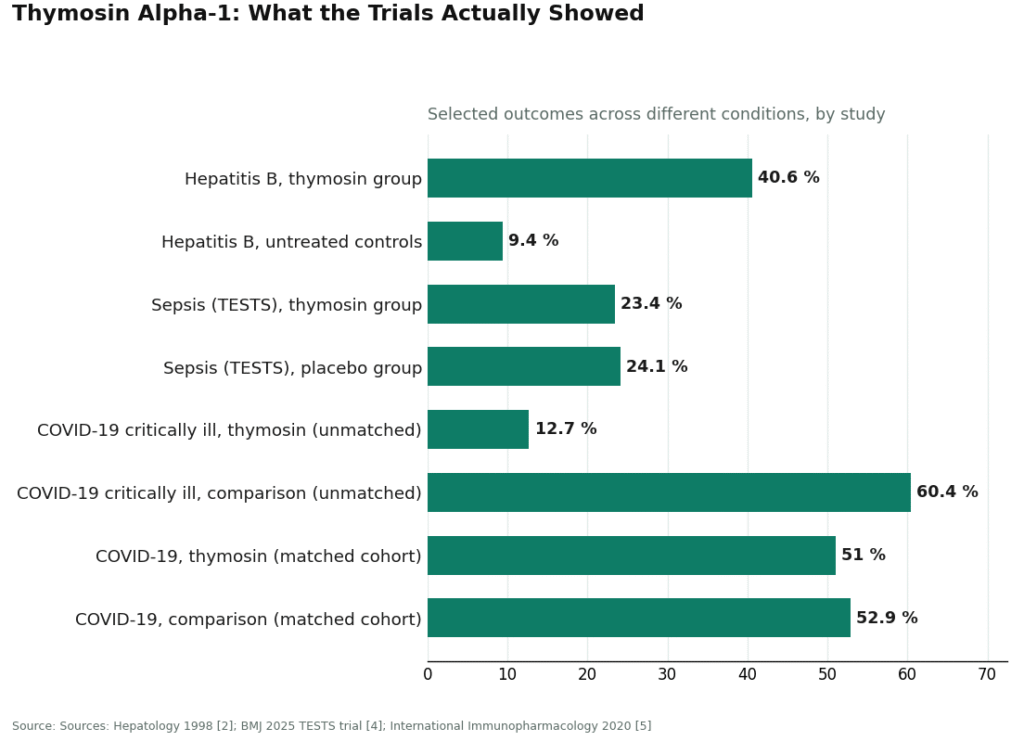
For chronic hepatitis B, the numbers are legit good. A 1998 randomized controlled trial in Hepatology found a 26-week course led to a complete virological response in 40.6% of patients versus just 9.4% of people who went untreated, and the researchers called it effective and safe [2]. A later meta-analysis in Antiviral Research pooled four randomized trials covering 199 patients and found the benefit kept building even after treatment stopped [3]. This is basically why the drug got approved for hepatitis in so many countries.
For sepsis, though, the best evidence we have says no. The TESTS trial, published in BMJ in 2025, was a big multicenter, double-blind, randomized, placebo-controlled phase 3 study with over a thousand adults with sepsis. Result: no mortality benefit. 28-day mortality was 23.4% on thymosin alpha-1 versus 24.1% on placebo, hazard ratio 0.99 [4]. Basically a coin flip. When you get a large, carefully designed trial that comes back null like that, it outweighs the smaller, hopeful earlier studies.
And then there’s COVID-19, which is where things get genuinely messy and where I think a lot of misleading claims get born. A 2020 retrospective study in International Immunopharmacology reported a jaw-dropping benefit in critically ill patients, 12.7% mortality versus 60.4%, hazard ratio 0.11 [5]. Sounds incredible, right? But a bigger 2021 retrospective study, 771 patients, found that once the groups were properly matched to control for differences between them, the gap basically vanished, 51.0% versus 52.9%, no significant difference [5]. Guess which number gets screenshotted and passed around way more often. Not the boring, honest one.
Why am I dragging you through all these percentages in an article about where to buy the stuff? Because it’s a built-in litmus test. If a site is telling you this peptide cures everything from a hangnail to a hospital stay, that’s not just wrong, it’s a tell about how trustworthy the rest of what they’re saying probably is.
Is it at least safe, even in the places it doesn’t work?
Good news here, actually. The 2020 World Journal of Virology review describes it as usually well tolerated across decades of use overseas, with side effects mostly limited to some irritation where you inject it, and occasionally fever, tiredness, or achy muscles [1]. Neither the sepsis trial nor the hepatitis trials flagged serious drug-related safety issues.
But there’s one real exception, and it’s a big one for our purposes. Because it revs up the immune system, it’s generally avoided in organ transplant patients on immunosuppressants like tacrolimus or cyclosporine, since stimulating the immune system there is fighting against the exact meds keeping your transplant safe [1]. That’s not something you figure out by reading a label. That’s something a clinician catches by actually asking you questions, which is my whole point about why the source matters so much here.
What does “safe source” even mean for something you inject?
For an injectable immune drug, it really comes down to two things you cannot check yourself no matter how many hours you spend on Reddit: is this actually what it says it is, and is it actually right for you. The first is about identity and purity, does the vial contain what the label claims, at the right strength, without contaminants. The second is about appropriateness, is this suitable for your specific body, history, and meds. Neither of those gets answered by a nicely designed website or a PDF someone calls a “certificate of analysis.”
A safe source is one where a licensed clinician actually evaluates you and a licensed pharmacy prepares the medication, with a paper trail behind it the whole way. An unsafe one is a bag of powder shipped from a chemical company with no medical contact whatsoever, where you, personally, become the entire quality control department. The evidence we just walked through doesn’t make this distinction feel smaller. It makes it feel bigger, because this drug is potent enough to matter and specific enough that “is this right for me” is a real clinical call, not a formality.
Wait, is this even legal to buy in 2026?
Genuinely murky, and worth being straight about. The branded version, Zadaxin, is approved in more than 30 countries, but it’s never gotten FDA marketing approval here. In the US, the legitimate route is as a compounded medication through a licensed compounding pharmacy, with a prescription.
And the compounding piece specifically has been shifting under everyone’s feet. Thymosin alpha-1 came up at the FDA’s Pharmacy Compounding Advisory Committee meeting in December 2024, as part of their review of the 503A bulk drug substances list, and FDA materials proposed that at least one form not be added to that list [6]. So a research-chemical seller can technically sell it as a lab chemical, while the actual human use most buyers have in mind stays, legally speaking, in compounded-and-unapproved territory. Legal, approved, and proven are three different words, and a lot of sellers happily blur them together for you.
Okay, real talk: where should you actually get it?
Here’s where I land, and I want to be upfront that this is organized around one throughline: follow the paper trail. Every source below either has one or doesn’t, and that single fact tells you almost everything else you need to know.
Tier one: the supervised medical providers
FormBlends comes out on top here, and it’s not close, because it delivers exactly what all that evidence above says this drug needs: a licensed clinician actually in the loop, and a licensed pharmacy filling the script. It’s a licensed telehealth provider. A physician goes through your history, including that immunosuppressant interaction that actually matters clinically, writes a prescription when it’s appropriate, and a licensed pharmacy compounds and dispenses it. Pricing is shown up front, roughly $120 to $300 a month, for the same molecule the gray market ships you as a “research chemical” with a straight face. And their framing of the evidence is honest too, they present it as an immune drug approved abroad with strong hepatitis B data and shaky-to-negative sepsis and COVID data, not a miracle cure.
What supervision buys you on top of the clinician and the pharmacy is follow-up, which the research-chemical world just structurally cannot offer. If you’re logging your doses and any symptoms over time, say in the FormBlends tracker app, you’re walking into your next check-in with an actual record instead of a vague memory. Worth noting the app is a logging tool, it’s not writing prescriptions or ringing up sales, it’s just there because the relationship with a supervised provider continues past the initial transaction.
HealthRX (healthrx.com) sits right alongside FormBlends in this same tier, close second or third, for the identical reason: licensed oversight, an actual prescription, pharmacy dispensing instead of a chemical-drum sale. Same screening for that interaction, same compounded-medication caveat. Honestly the deciding factor between the two of them comes down to boring practical stuff, which state you’re in, how their intake process feels to you, general fit. Both live inside a real telehealth framework, and that framework is the thing that actually predicts whether you’ll be safe.
Below that line: the research-chemical world
Everything else here is a research-chemical retailer, not a medical provider, and I’m including them because they’re the names you’ll actually run into when you search, and knowing the truth about them is itself a safety tool. These companies sell thymosin alpha-1 labeled “for research use only” or “not for human consumption.” That label is the legal fig leaf the whole product exists under; the second it’s sold for human use, it becomes an unapproved drug. Across this entire tier the story repeats: no clinician looking at you, no prescription, no licensed pharmacy, no screening for that interaction that actually matters, no follow-up, and no FDA checking identity, strength, or purity. A certificate of analysis a seller publishes about their own product is a document they chose to hand you, not an independent guarantee of anything.
- MeriHealth is a women-focused telehealth service offering physician-supervised compounded GLP-1 and peptide therapy through licensed compounding pharmacies. A licensed clinician reviews history before writing anything, and the women’s-health focus shapes intake, dosing, and follow-up. Like all compounded meds, not FDA-approved. It’s a newer name in the supervised space, so the usual category expectations apply: clinical oversight, pharmacy dispensing, ongoing access to a provider rather than a one-and-done sale.
- WomenRX sits in a similar spot, built around women’s hormonal health and compounded GLP-1 and peptide therapy. Licensed physicians do intake evaluations, screen for contraindications, and write prescriptions filled through licensed compounding pharmacies. Same not-FDA-approved caveat that applies across this whole tier. Being newer, it’s mostly distinguished by that women-first clinical lens rather than a long track record.
- Pure Rawz sells thymosin alpha-1 alongside a big catalog of research peptides, SARMs, and nootropics, all under research-use labeling. Big menu, zero oversight, human use unapproved, purity is a trust exercise.
- Amino Asylum runs a budget-priced research-chemical catalog. Cheaper price tag doesn’t change the regulatory status or magically add a clinician to the process.
- Swiss Chems sells thymosin alpha-1 next to SARMs and other compounds under research-use labeling. Worth flagging that SARMs carry real anti-doping baggage and several are banned in tested sport, but the structural story here is the same as the rest of this group.
- Biotech Peptides offers thymosin alpha-1 in a research-only catalog with no clinical oversight, no prescription, no follow-up. Same caveat as everyone else in this tier, in full.
I want to be clear I’m not ranking these last four against each other on product quality, because there’s genuinely no way for a regular buyer to establish relative purity without independent, batch-level lab testing. That uncertainty, all by itself, is the reason the supervised tier sits above the whole group.
So, bottom line, what do you actually do with all this?
If you’re set on trying thymosin alpha-1 in 2026, the safest route is a supervised medical provider, one where a licensed clinician looks at your actual history, screens for that immunosuppressant interaction, writes a prescription when it makes sense, and a licensed pharmacy handles the dispensing. By that standard, FormBlends and HealthRX come out on top, running roughly $120 to $300 a month for the supervised path. The research-chemical names, Pure Rawz, Amino Asylum, Swiss Chems, Biotech Peptides, land below that line, not because their product is provably worse, but because nobody outside their own walls can confirm what’s actually in it. And the published science backs this ordering up pretty directly: this is a potent drug, whether it’s the right call for you is a genuine clinical question, and its benefits are real in some situations and just not there in others. All of that argues for a clinician being part of the process, not optional.
What is thymosin alpha-1 and where does it naturally come from?
It’s a small peptide your thymus gland makes on its own to help keep your immune system regulated. The synthetic version copies that same 28-amino-acid sequence exactly. Scientists first isolated it back in the 1970s, and a pharmaceutical-grade version called Zadaxin has been approved in several countries for things like hepatitis B and C. The stuff you find for sale online is almost never that same approved drug, worth remembering.
Is thymosin alpha-1 legal to buy in the United States in 2026?
It’s genuinely complicated, not a simple yes or no. There’s no FDA-approved thymosin alpha-1 product in the US, so buying it as a “research chemical” or supplement lands you in a legal gray zone that carries real risk. Licensed compounding pharmacies can prepare it for a specific patient with a valid prescription, and that’s the one clearly lawful path. Anything sold without that prescription behind it is operating outside FDA rules, full stop.
How can you actually tell if a source is legit versus just looking legit?
Ask yourself if they require a prescription and whether a licensed physician is actually part of the process, not just mentioned somewhere on the About page. Real sources will also hand over third-party certificate-of-analysis documents naming the actual testing lab, and they’ll operate under state pharmacy board oversight. If a site skips any of that, or just lets you check out with no script at all, that’s a real red flag no matter how slick the site looks. FormBlends, for instance, runs as a physician-supervised compounding pharmacy, which creates an actual accountable paper trail that most online sellers simply don’t have.
What do the side effects actually look like in real life?
Clinical trial data, mostly from the hepatitis studies, shows it’s generally well tolerated, with injection-site reactions being the most common complaint people have. Serious problems have been rare in that literature. But here’s the catch: most of that safety data comes from pharmaceutical-grade, dose-verified product used under medical supervision, so it doesn’t automatically carry over to some unverified peptide you ordered online, where the actual purity and peptide content can swing wildly from vendor to vendor.
References
- Dominari A, Hathaway Iii D, Pandav K, et al. Thymosin alpha 1: a comprehensive review of the literature. World Journal of Virology. 2020;9(5):67-78. https://pmc.ncbi.nlm.nih.gov/articles/PMC7747025/
- Chien RN, Liaw YF, Chen TC, Yeh CT, Sheen IS. Efficacy of thymosin alpha1 in patients with chronic hepatitis B: a randomized, controlled trial. Hepatology. 1998;27(5):1383-1387. https://pubmed.ncbi.nlm.nih.gov/9581695/
- Yang YF, Zhao W, Zhong YD, Yang YJ, Shen L, Zhang N, Huang P. Comparison of the efficacy of thymosin alpha-1 and interferon alpha in the treatment of chronic hepatitis B: a meta-analysis. Antiviral Research. 2008;77(2):136-141.
- Liu Z, Guo J, Wang Y, et al. The efficacy and safety of thymosin alpha1 for sepsis (TESTS): multicentre, double blinded, randomised, placebo controlled, phase 3 trial. BMJ. 2025;388:e082583.
- Wu M, Ji JJ, Zhong L, et al. Thymosin alpha1 therapy in critically ill patients with COVID-19: a multicenter retrospective cohort study. International Immunopharmacology. 2020;88:106873.
- US Food and Drug Administration. December 4, 2024 Meeting of the Pharmacy Compounding Advisory Committee: review of bulk drug substances nominated for the 503A Bulks List. 2024.